L-Carnitine L-Tartrate
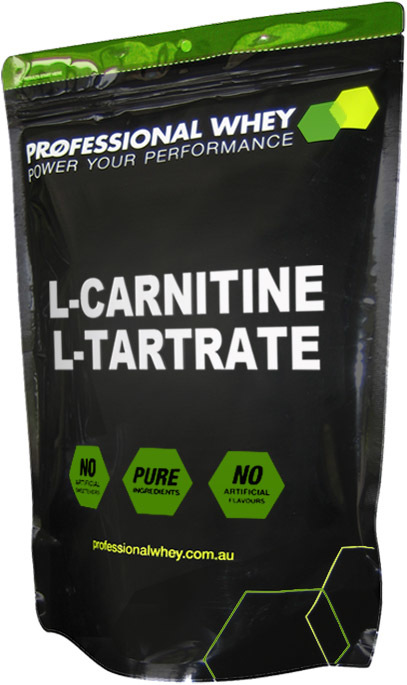
Studies show L-Carnitine L-Tartrate may assist in:
- Supporting Fat Transport into the Mitochondria for Energy Metabolism¹
- Supporting Glycogen Sparing & Energy Availability²³
- Supporting Reduced Lactate Accumulation During High Intensity Activity⁴
- Supporting Post-Exercise Recovery and Reduced Muscle Soreness²⁵⁶
- Supporting Antioxidant Balance & the Body’s Response to Exercise-Related Stress³⁶
- Supporting Aerobic Performance Measures⁷
250g
L-Carnitine L-Tartrate is a well-studied form of L-Carnitine, often included in sports nutrition due to its high bioavailability and potential role in energy metabolism and recovery.
L-Carnitine is a nitrogen containing compound derived from the amino acids L-Lysine and Methionine. In the body, it helps transport long-chain fatty acids into the mitochondria where they can be used to produce energy. The “L-Tartrate” form combines L-Carnitine with L-Tartrate, a compound that enhances stability and absorption.
Studies have investigated L-Carnitine L-Tartrate in relation to the following:
- Supporting fat transport into the mitochondria for energy metabolism¹
- Supporting glycogen sparing and energy availability²³
- Supporting reduced lactate accumulation during high-intensity activity⁴
- Supporting post-exercise recovery and reduced muscle soreness²⁵⁶
- Supporting antioxidant balance and the body’s response to exercise-related stress³⁶
- Supporting aerobic performance measures⁷
Other Areas of Research:
In research, L-Carnitine L-Tartrate has also been examined for:
- A 2021 randomised controlled trial found supplementation improved recovery, reduced fatigue, and increased antioxidant enzyme activity after 5 weeks of training⁶.
- A 2023 review concluded L-Carnitine may support post-exercise recovery, especially in individuals with lower baseline levels⁸.
- A 2024 meta-analysis reported supplementation was associated with lower post-exercise lactate levels and improved VO₂ max in trained individuals⁷.
Non GMO, Gluten free and suitable for vegans.
Available in 250g packs.
References
1: Wutzke 2004, 2: Volek 2002, 3: Bucioli 2012, 4: Wall 2011, 5: Swart 1997, 6: Stefan et al 2021, 7: Fukata et al 2024, 8: Fairman et al 2023
__________________________________________________________________
Formulated Supplementary Sports Food
Not to be used as a sole source of nutrition. This product should be used in conjunction with a healthy, nourishing diet and an appropriate physical training or exercise program. Not suitable for children under 15 years of age or pregnant women: should only be used under medical or dietetic supervision.
Studies show L-Carnitine L-Tartrate may assist in:
- Supporting Fat Transport into the Mitochondria for Energy Metabolism¹
- Supporting Glycogen Sparing & Energy Availability²³
- Supporting Reduced Lactate Accumulation During High Intensity Activity⁴
- Supporting Post-Exercise Recovery and Reduced Muscle Soreness²⁵⁶
- Supporting Antioxidant Balance & the Body’s Response to Exercise-Related Stress³⁶
- Supporting Aerobic Performance Measures⁷
Consume 2-3g of L-Carnitine L-Tartrate in 2-3 separate doses, daily in 100ml of water.
Best Results: If taken pre & post workout.
And also stacks well as part of:
The Ultimate Stack (Pre (30 mins) & Post (30 mins) Workout - Drink Half Pre Workout and Half Post Workout)
Ingredients:
600-1200ml of Water
(3g) 1/2 tsp Creatine Monohydrate
(5g) 1 tsp Glutamine
(3g) 1 tsp HMB Powder
(10g) 2 tsp IBCAA 4:1:1
(5g) 2 tsp Betaine Anydrous TMG
(4.5g) 1 tsp Beta Alanine
(4g) 1 tsp Taurine
(3g) 1 tsp L-Ornithine
(6g) 2 tsp Citrulline Malate 2:1
Add protein if required i.e (Pre & Post) 1/2 - 1 scoop of Hydrolysed Protein/WPI
Add carbs if required i.e (Pre) 1/2 scoop of Organic Instant Oats (Post) 1 scoop Dextrose
N.B L-Carnitine L-Tartrate does not pre mix and store well due to its high moisture content, so we do not recommend adding it in bulk to The Ultimate Stack.
Serving Size: 1/3 tsp (1g)
Servings Per 250g: 250
Ingredients: Pure L-Carnitine L-Tartrate
Easy and convenient
By: Diane Tregear on 6 July 2023Prompt delivery. Convenient resealable packaging.
(5)
Good product
By: Wendy Jones on 20 May 2022Have been religiously taking this for a number of years now with Beta Alanine and it serves me well.
(5)
pre-workout
By: Elizabeth Hannigan on 23 June 2019I have this prior to my gym session mixed with creatine on a regular basis. Find it helps during a session and after for recovery...
(5)
Amazing!
By: Hedy Thurzo on 9 June 2019I purchased L-carnitine L-tartrate a couple of weeks ago and was amazed at how much more energy I had and endurance whilst doing my workout. I found that I could increase my weights easier than without taking this wonderful product. Taking a dose 15-30 mins before starting, and immediately afterwards, kept my energy levels up. It has an unusual smell but tastes ok. I definitely recommend this for anyone who wants to workout with peak performance. Also, I'm new to taking any of this type of product or supplement and I'm so happy I have. Great quality. Great performance. Natural.
(5)
Excellent for shedding unwanted fat
By: Philomena Terry on 4 April 2018Highly recommend this product and wouldn’t be purchasing anywhere else. Since I’ve started taking this supplement, I have seen massive changes with my body. I will keep repurchasing this product and the most amazing part about it is It’s pure without any artificial flavours and Supper affordable. Thank you for the amazing product.
(5)
Unexpected Necessity
By: Jessica Warland on 23 May 2017I got started on this product to help with my bikini competition prep, I'd never heard of it before my coach recommended it but now that I've been using it for a while I wonder how I went without. It's seriously helped with my body composition and burning fat, alongside that it helps me go into my workouts focused and after working out helps my muscles recover faster so I'm actually able to function the next day at work after a killer workout. Definitely recommend.
(5)
Awesome!
By: Caitlin Williams on 8 January 2017Using just small dose for about a month, I've found myself with more energy and endurance during the day and my workouts. I've definitely noticed fat loss. Sure, the stuff smells pretty rank in the bag (so try not to sniff the bag), but it has a lemony flavour that I quite like. The only downside I've experienced is that it gives me constipation at a higher dosage, easily managed by decreasing the dose and increasing fibre and water intake.
(5)
Lost without it
By: Todd on 7 March 2016I'm so glad I've caught onto professional whey's L caritine product. I train intensely 6 days a week. I always have and alway will but this product has given me the edge I've been looking for. My recovery times are low. My fat metabolisation is high. I have this 3 times a day and I'm set. Nothing stops me and results just keep coming. This added into a balanced diet will push you over the line and renew your passion for working out and seeing results. About to order some more!
(5)
Great product
By: Lucy on 26 February 2016I had plateaued with my weight loss but this product helped me lose the last couple % of body fat. I also felt like I had more energy whilst working out
(5)
Mr
By: Paolo on 29 July 2015I originally took this product not for it's fat loss properties, but to help aid my recovery and mental focus. It definitely has helped my recovery and I have lost a bit of weight since I've been on it. But I'm not sure if it was due to the product, the training or both.
(4)
Actual results
By: Loic Savrimoutou on 16 January 2014I hit a bit of a wall with my fat loss, despite sticking to my caloric goals. Taking this twice daily (upon waking up and with lunch) has helped me break through that plateau and am seeing some serious vascularity. A little pricey, but totally worth it. Smells a bit odd, but has a pleasant lemon taste when mixed with water. Tastes awful with any kind of whey protein.
(5)
A great product
By: Abby Raupach on 15 January 2014A great product at an even better price. Taking this twice per day has helped me with my focus and fat loss efforts. The taste is pallatable and not as potent as other Lcarnitine brands. Another great product by professional whey with a very prompt customer service team and delivery times - there is nothing to fault here at all! I would love to see a small scoop include in the bag OR available for purchase.
(5)
Great Taste!
By: Corrina Steele on 4 January 2014Although this stuff stinks, it has a pleasant fruity taste. I just mix in water and it's easy to drink, fully dissolves. Early days for me so can't attest to results, but I am confident in Professional Whey's products.
(5)
Essential for Cutting!
By: Lachlan Dodd on 3 January 2014I found this a great help for me to lose that little extra fat combined with an appropriate diet/cardio/weight training when cutting. dont be mislead when you open your package! its a small bag but great value for money with 100 serves!
(5)
No placebo effect here, this is the real stuff
By: Anthony Agnew on 1 November 2013I have taken the Carnitine on (for 4~6wks at a time) and off (again for 4~6wks), several times just to compare and confirm results in a controlled manner. I take it 1~2g in the morning first thing when i wake up, and in the afternoon before a work out. when I'm on it, the same gym routine work outs becomes noticeably easier, especially cardio work outs - recovery time for resistance/weights becomes shorter and overall fitness levels feels better all round compared to when I'm off it. I'm at the lightest weight I have been in the last 10 years and keen to see how much further I can push with this great product. taste is ok, but just gulp it down and wash it down with another glass of water, dont even stress it :P
(5)
Totally Surprised Me
By: Zoe James on 22 October 2013Palatable was nice but I consistently feel a difference both when I work out and for the rest of the day. Top product.
(5)
Morning routine
By: BRADLEY HENDERSON on 16 September 2013I have been using this product for approx 8wks now and have definitely achieved results. I add it to my morning glass of water and fresh squeeze of lemon. PROFESSIONAL WHEY is a favourite brand of mine
(5)
Great improvement!
By: Sylvano Cergnulli on 6 September 2013Been taking L-Carnitine for a couple of months now to get a little less body fat percentage and i can honestly say that this product has worked for me.I will keep using this product and have gotten a few of my friends on it too with some success in a short period.Very happy!!!!!
(5)
Amazing Result!!!!!
By: Antonio dormio on 19 August 2013Great product!!! i will never achieved 20 kg weight loss!!! amazing result, early morning just it works perfect, good taste and no heart burn like these tablets from the chemist. I will buy definitely more because i finally find something that work!
(4)
Great tasting FAT KILLER!
By: Len Chandler on 7 July 2013I've recently bought 2 X 250g packets of L-Carnitine L-Tartrate after doing some research regarding the issue of FAT LOSS. I've also started doing some gym work targeting muscle mass. The idea is to rid my body of excessive fat thus expediting visible muscle gain...it tastes great (fruity flavor) and I drink it as a stand alone product although it can be mixed with protein powders. I mix 5g of L-Carnitine L-Tartrate with 100ml water drinking the solution before and after a gym workout. My wife also uses L-Carnitine L-Tartrate purely for weight loss purposes, she drinks 5g of L-Carnitine L-Tartrate with 100ml water before and during her cardio exercises.
(5)
Helps shred !!
By: Jade Small on 31 May 2013Works great in helping me lose fat !
(5)
PeterW
By: Peter Wilson on 11 December 2012I believe Professional Whey supply quality product in no nonsense packaging. This is another example. Early days yet but I notice a slight change in my endurance. Can't attest to the fat burning ability yet but we will see. It is an acquired taste but would give it a second look.
(4)
Another great product!
By: Adam Usher on 24 May 2012Another quality product from the team at Professional Whey. Easily the best value, best tasting Carnitine i've used, and it has helped me to shed those last few stubborn kilos. I will definitely be buying this one again!
(5)